
Resources for Avoiding Creative and Professional Burnout

Burnout is a growing concern across many industries, including technology, healthcare, education, creative services, and corporate environments. Research consistently shows that prolonged heavy workloads, long hours, and limited organizational support place professionals at high risk for chronic stress and exhaustion. Over time, these conditions can lead to decreased productivity, emotional fatigue, disengagement, anxiety, sleep disturbances, and other physical and psychological symptoms.
While burnout is not a new phenomenon, its prevalence has increased as modern work environments demand constant availability, rapid output, and sustained performance under pressure. Burnout is now considered an official medical condition, appearing in the World Health Organization’s International Classification of Diseases (ICD-11) as a syndrome caused by chronic workplace stress that has not been successfully managed. Many professionals are expected to balance competing priorities, adapt to continuous change, and maintain high standards with fewer resources. These pressures can compound over time, leaving individuals feeling depleted, overwhelmed, and disconnected from their work.
Creative professionals—including designers, writers, strategists, and other problem-solvers—often experience burnout in particularly complex ways. In addition to professional exhaustion, they may face creative burnout, a condition marked by diminished inspiration, difficulty generating ideas, and an inability to engage meaningfully in creative tasks. Because creativity is frequently tied to personal identity, this type of burnout can be especially distressing, affecting both professional performance and overall well-being.
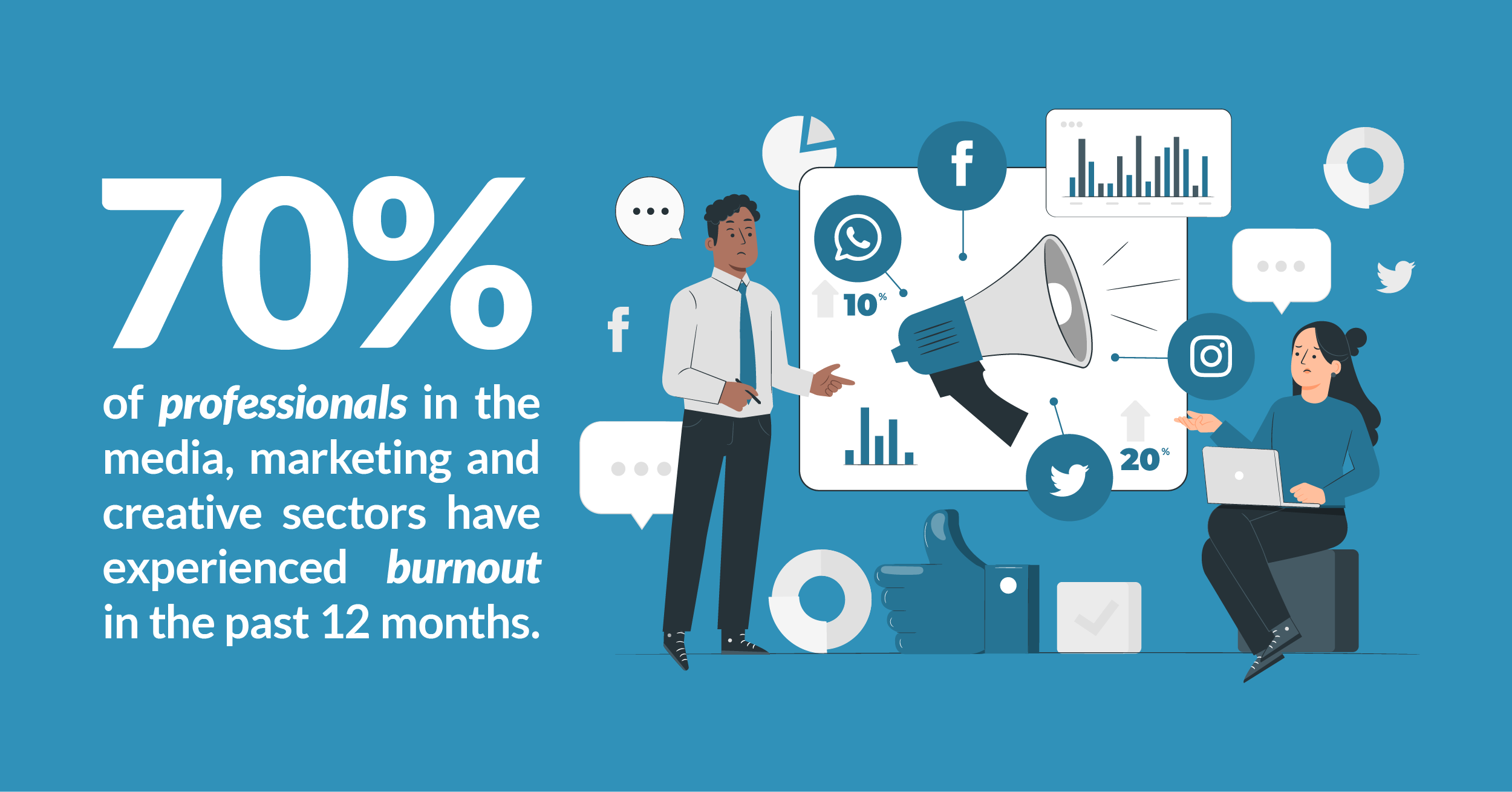
The Relationship Between Creativity and Burnout
Professional and creative burnout is not a single, uniform experience; researchers and practitioners generally describe several distinct types of burnout that affect people in different ways depending on workload, motivation, and environment.
One of the most widely recognized frameworks comes from the work of Christina Maslach, whose research underpins the Maslach Burnout Inventory. In this model, burnout includes three core dimensions:
- Emotional exhaustion: feeling drained, depleted, and unable to give more of oneself psychologically.
- Depersonalization (or cynicism): emotional distancing, irritability, or a negative, detached attitude toward work or clients.
- Reduced personal accomplishment: feelings of inefficacy, self-doubt, and a sense that one’s work no longer feels meaningful or effective.
This framework is commonly used in healthcare, education, and corporate settings to assess professional burnout.
Building on this research, later writers have described subtypes of professional burnout that help explain differences in how burnout presents. These include:
- Overload burnout, which arises from excessive demands, long hours, and chronic overextension.
- Under-challenge burnout, caused by boredom, lack of growth opportunities, or monotonous tasks.
- Neglect burnout, which occurs when individuals feel helpless, unsupported, or unable to meet expectations and gradually disengage.
These distinctions clarify why some burned-out individuals feel frantic and overwhelmed, while others feel numb, apathetic, or resigned.
Creative burnout shares many features with professional burnout but has unique characteristics tied to identity and output. Creative professionals—such as writers, designers, artists, and researchers—often experience burnout as loss of inspiration, creative paralysis, or fear that their work no longer meets internal standards. This form of burnout is frequently linked to perfectionism, identity fusion with one’s work, irregular income, and constant pressure to generate novel ideas. Unlike task-based burnout, creative burnout can feel existential, affecting not just productivity but a person’s sense of self and purpose.
At an institutional level, burnout is recognized as an occupational phenomenon by the World Health Organization, which defines it as a syndrome resulting from chronic workplace stress that has not been successfully managed. The WHO emphasizes that burnout is specific to work contexts and highlights the importance of organizational factors—such as workload, autonomy,
Tips for Individuals on Preventing Burnout
- Set and protect realistic boundaries around work time, availability, and workload. Consistently limiting overwork helps prevent chronic exhaustion and cognitive overload.
- Monitor early warning signs such as irritability, cynicism, fatigue, reduced motivation, or declining performance, and treat them as signals to adjust rather than push harder.
- Prioritize regular recovery through sleep, breaks, and time off. Recovery is not optional; it is a necessary counterbalance to sustained effort.
- Maintain a sense of autonomy by clarifying what you can control, making intentional choices about commitments, and renegotiating demands when possible.
- Diversify sources of meaning and identity so that self-worth is not tied exclusively to productivity or professional success.
- Build consistent routines that support physical regulation, including movement, nutrition, and exposure to daylight, which directly influence stress resilience.
- Use self-compassion rather than self-criticism when performance dips. Harsh self-judgment increases burnout risk and reduces adaptive problem-solving.
- Seek social support through peers, mentors, friends, or professional communities, especially those who understand the specific demands of your work.
- Create psychological distance from work during non-work time by engaging in absorbing, non-evaluative activities that do not center on achievement.
- Periodically reassess goals and values to ensure alignment between effort and what genuinely matters, adjusting course before exhaustion becomes entrenched.
Ways You Can Stay Inspired During Burnout as a Creative Person
Even during periods of exhaustion or creative block, inspiration can be gently reintroduced.
- Protect creative energy, not just time.
- Separate idea generation from evaluation.
- Maintain creative input, not just output.
- Work in sustainable rhythms.
- Keep a low-pressure “play” practice.
- Diversify projects.
- Limit comparison.
- Reconnect with intrinsic motivation.
- Build a supportive creative community.
- Accept creative fallow periods.
- Maintain basic physiological care.
- Set process-based goals instead of outcome-only goals.

Free Mental Health Resources for Preventing Burnout
Free Burnout Assessment Tools
Burnout Assessment Tool
A research-based self-report questionnaire developed by KU Leuven that measures core burnout symptoms such as exhaustion, mental distance, and cognitive and emotional impairment. It is designed for structured assessment rather than diagnosis.
Maslach Burnout Inventory
A widely used, standardized burnout measure that assesses emotional exhaustion, depersonalization or cynicism, and reduced personal accomplishment. It is proprietary and commonly used in research and organizational settings.
Psychology Today Burnout Test
A brief online self-assessment that helps individuals reflect on work-related stress and burnout symptoms. It is intended for personal insight rather than clinical evaluation.
Burnout Assessment Form
A short checklist-style form that helps individuals identify common warning signs of burnout based on recent experiences. It is primarily for self-awareness and reflection.
Beyond Blue – Burnout Checkin Tool
An informal online tool that asks questions about how work is affecting wellbeing and provides general feedback and suggestions. It is designed as a quick check-in rather than a diagnostic measure.
Burnout Prevention Resources
Preventing Burnout: A Guide to Protecting Your Well-Being
An article from the American Psychiatric Association offering practical steps and psychological insights for reducing stress and preventing burnout, including lifestyle and work adjustments.
5 Ways to Prevent and Overcome Burnout
A resource from NHSA outlining five actionable strategies to reduce the risk of burnout and support recovery, aimed at caregivers and professionals.
Manage stress, avoid burnout, and stay inspired
An occupational therapy association page with tips for managing stress, maintaining motivation, and preventing burnout throughout one’s career.
Feeling burned out? How hobbies, laughter and enjoying community can help
A UC Davis Health blog post explaining how engaging in hobbies, laughter, and community activities can support wellbeing and reduce feelings of burnout.
Burnout: Signs, Causes and How to Recover
A Mental Health America page describing common symptoms of burnout, contributing factors, and steps for recovery and self-care.
Resources for Employers
Workplace Strategies for Mental Health
A collection of tools and guides to help employees cope with workplace stress and support mental health at work.
Workplace Stress
Guidance from OSHA on preventing and addressing workplace stress, including recommendations for employers to create healthier work environments.
HHS – Workplace Wellbeing Resources
A U.S. Department of Health and Human Services page with resources and reports aimed at improving workplace wellbeing and mental health.
NAMI – Mental Health and Burnout: A Guide for Managers
A National Alliance on Mental Illness guide offering managers practical advice for recognizing and addressing burnout among team members.
CDC – Providing Support for Worker Mental Health
A CDC resource offering information on ways employers and organizations can support employee mental health and wellbeing.
Resources for Talking to Your Boss About Burnout
Harvard Business Review – How to Tell Your Boss You’re Burned Out
An HBR article with communication tips and conversation strategies for telling a supervisor about burnout and asking for support.
How to Talk About Burnout At Work
A guide from Stress & Resilience focused on how to approach conversations about burnout with colleagues and supervisors.
AskHR: How to Talk to Your Manager About Burnout
An SHRM article with practical advice on framing a discussion with a manager about feeling burned out and seeking accommodations.
Job Burnout: How to Spot It and Take Action
A Mayo Clinic overview that explains signs of job burnout and suggests ways to address it, including how to discuss it with others.
6 Signs You’re Burned Out: How to Cope and Prevent It
A short publication with six key burnout signs and accompanying tips for coping and prevention.
Research on Burnout
Understanding the burnout experience: recent research and its implications for psychiatry
A scientific article reviewing research on burnout, its psychological features, and implications for clinical practice.
Burnout phenomenon: neurophysiological factors, clinical features, and aspects of management
A research paper discussing neurophysiological underpinnings of burnout, clinical symptoms, and treatment considerations.
Burnout and stress: new insights and interventions
A research article providing insights into burnout mechanisms and intervention strategies.
Revitalising burnout research
A scholarly article arguing for new directions in burnout research to deepen understanding of its causes and consequences.
Burnout: a comprehensive review
A comprehensive review paper summarizing burnout research, theories, and findings across disciplines.